You are a cyber ghost , forgetting bread , forgetting gravity, forgetting the high temperature red warning , floating to the blue dome of Notre Dame , and even passing through it... I have no intention of making any artistic remarks . Although you fly to heaven along the spire of the Gothic church in the VR device , the wrapping feeling of the sofa and the pop-up window of the game console still remind you : you are not the climax soul of St. Theresa , you are still slumped in the study . Back to reality, I have never been to the offline site . But maybe the offline display is just an art derivative , and the art itself is actually in the virtual Notre Dame? The artist said that there are still many works that exist in the form of code and cannot be exhibited or collected. But code or digital as the third persistence or third pre-storage is no more virtual than the concept - Zhuangzi's butterfly or Duchamp's urinal - but continues the rebellion against the museum.
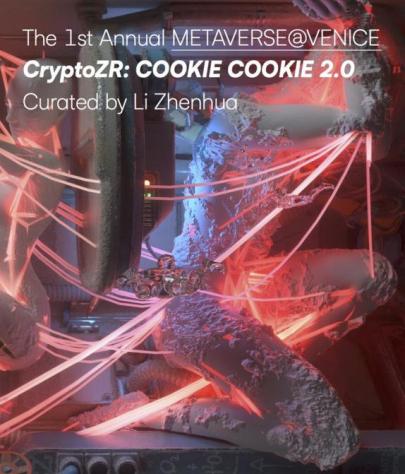
Talking about money in Notre Dame may be absurd , but the work "Small Goals" is just like that . "Small Goals" originated from the Chinese Internet. A rich man sincerely and absurdly warned young people : set a small goal first, such as earning 100 million. The artist tried to show the fragility of personal property through virtual currency . The virtual currency SG was randomly issued to users using the Ethereum ERC20 protocol . Users will find that there are 100 million more currency assets in their accounts , but when they want to circulate or exchange this currency, the 100 million assets disappear, like a dream bubble .
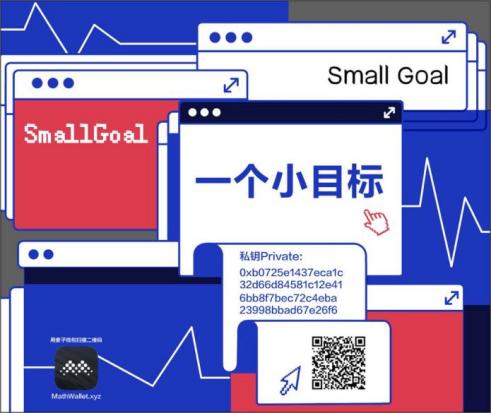
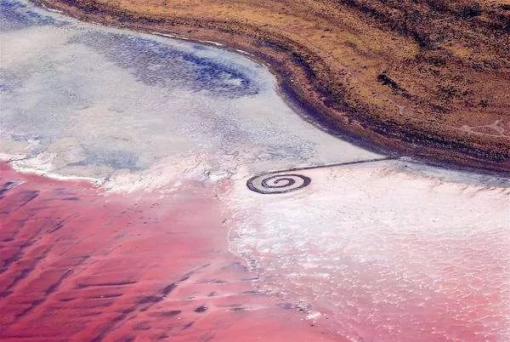
Because the work of artists is difficult to present visually , the user's attitude towards 100 million assets should be an important exhibition text , but only the documentary is played in the museum. This is similar to Hans Haacke's investigation of real estate, but Hans Haacke showed the process and plan of the activity to the audience . There is no difference between watching the blockchain social experiment documentary in the virtual pavilion and watching the documentary "Spiral Jetty" in the real pavilion. Art only shows itself in social experiments and magnificent landscapes, and the audience only feels the poor fragments of aura through images. David Chalmers went to great lengths to prove that "virtual reality is the real reality ", which defended the metaverse as a scene. But at this time, art is neither in Spazio Thetis nor in the virtual Notre Dame. Failure to make a breakthrough in the scene is definitely not the original intention of building a virtual pavilion.
Crossing the dome of Notre Dame, the work "Red and Blue" is on the wall of the Hundred Flowers Window. The color matrix is like the red and blue pill fable in the movie "The Matrix" . Swallow the red and give up fantasy, or swallow the blue and give up reality. This work is created by the artist against the backdrop of the Sino-US trade war , using the red and blue colors of the national flags of China and the United States as the two poles , generating 100 transitional color blocks, and auctioning them on OpenSea . As the situation in the Taiwan Strait heats up , the trade war is protracted, political and military confrontations , cultural collisions, and ideological confrontations , the red and blue positions have been infinitely magnified , which not only caters to the Cold War thinking in Western historical memory, but also makes China, which is tired of " catching up with Britain and surpassing the United States " , feel cultural shock and integration.
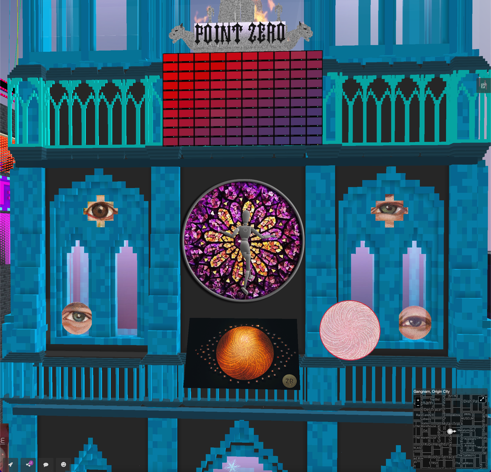
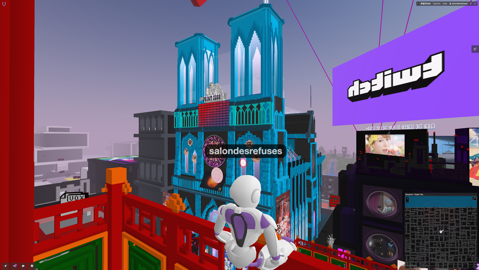
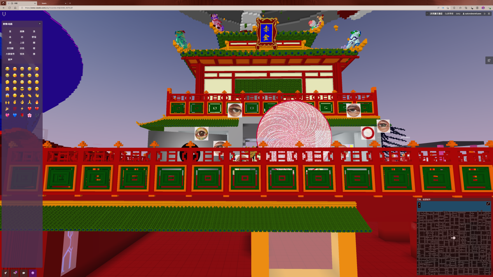
red and blue appearances of the two virtual exhibition halls facing each other across the street also implicitly reflect this opposition : the Red Gold Art Museum is shrouded by a spaceship in the sky, and the building itself is very similar to the Forbidden City of the Ming and Qing Dynasties, with red walls, green tiles and yellow glazed tiles, and digital auspicious beasts on the roof in front of the door. Inside the hall, there is a statue of the Great Sun Tathagata that runs through three buildings; the Origin Art Museum is a tribute to the Notre Dame fire in Paris in 2019. The structure is the same as the main body of Notre Dame, the whole body is crystal blue , and there are angel and demon sculptures guarding the door. There are two dynamic goddess sculptures one above and one below in the center line of the hall. The origin is named after the PointZero landmark in the Notre Dame Square : a metal plate engraved with a golden rose pattern and the inscription "Origin of French Roads" . Even if the same content is not worth watching repeatedly in multiple art galleries, it cannot be denied that these virtual buildings are very attractive. They are the most eye-catching works .
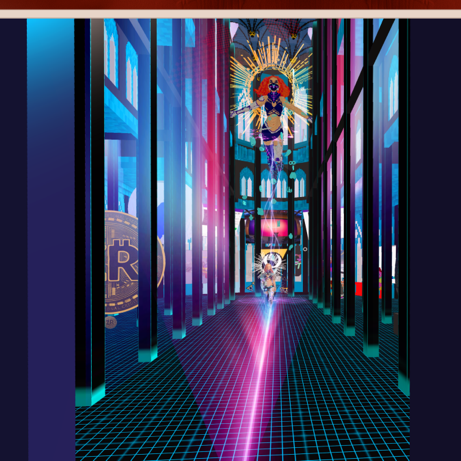
What is dramatic is that, just as the red and blue buildings are the work of the same artist, the same collector also bought the red and blue polar blocks . The year-long auction made the collector believe that the act of collecting will affect the connotation of the work and become part of the artistic behavior . It is time to wake up the brain full of ideological alcohol and re-discuss the issue of the red and blue pills : watching strangers ' concerts, dancing disco with avatars from all over the world, listening to Japanese monks singing "Great Compassion Mantra", and the red light district opposite the temple ... It is inevitable that ideology is brought into the virtual world , but the metaverse seems to have completed the transcendence of globalization with an amazing mix and match, giving crypto art the possibility of being a globalized art.
As Xu Yu said , today's "art and technology" refers to globalized art and digital technology, and it means that art uses technology . Liu Jiaying uses blockchain technology to bring conceptual art into the crypto world, and the dematerialization feature makes it distinct from a group of crypto pop artists. Lucy Lippard 's "dematerialization" refers to the phenomenon that since the 1960s , conceptual art usually uses concepts, time, process, landscape, performance , etc. , which are difficult to copy, display, and sell . Crypto pop art based on digital media does not have the characteristics of dematerialization . Works of conceptual art, such as Liu Jiaying's social experiments, financial wars, and codes, are dematerialized . Although conceptual art calls for rebellion against museums, it may be expected that virtual exhibition halls will respect this rebellion while gaining space for art and truth.
Art criticism · Salon des Refusés, July 2022.